
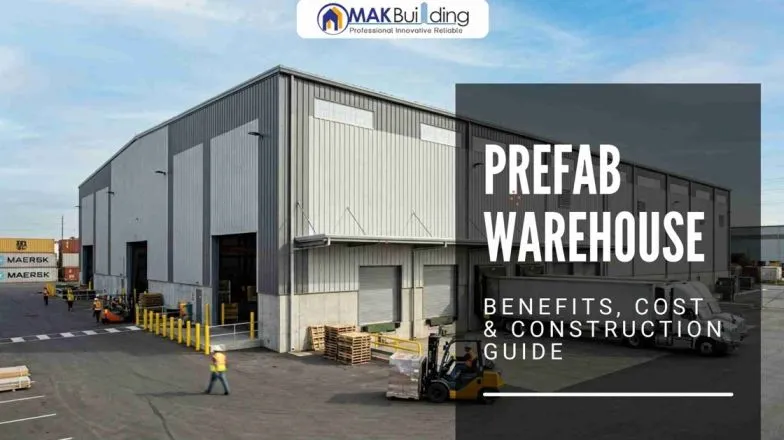
A Prefab Warehouse is a contemporary storage facility that is constructed with pre-engineered material that is produced in a factory and assembled at the construction site. Unlike traditional warehouses that require lengthy on-site construction, a prefabricated warehouse building is designed for faster installation, structural strength, and efficient use of space. Because of these advantages, many industries now prefer PEB warehouse construction for logistics, manufacturing, and storage facilities.
We are the MAK Building System we design and provide premium prefabricated warehouse building solutions that conform to the present day industrial demands. This guide explains what a prefab warehouse is, its benefits, the construction process, and the factors that influence prefab warehouse cost.
What is a Prefab Warehouse?
A Prefab Warehouse is a type of warehouse that is prefabricated into parts at a factory and then part often carried into the construction site to assemble in a short time. Rather than constructing all the structure on site, structural elements, which include columns, beams, roof panels, and wall sheets, are pre-designed and made in advance.
A prefabricated warehouse building typically uses steel as its main structural material because of its strength, durability, and flexibility. These buildings are also widely known as PEB warehouse construction (Pre-Engineered Building construction).
Because most of the manufacturing work is completed in a controlled factory environment, the installation process at the site becomes significantly faster and more efficient.
Key Features of a Prefabricated Warehouse
The contemporary prefabricated warehouse is engineered and has designs that are flexible. Few of its key features are:
- High structural strength with steel framework
- Large clear spans for maximum storage space
- Quick installation and modular design
- Customizable size and layout according to business needs
- Weather-resistant roofing and wall panels
- Low maintenance requirements
These features have made prefab warehouse building a solution to most industries rather than traditional brick and concrete warehouses.
Benefits of a Prefab Warehouse
1. Faster Construction
Speed is one of the greatest benefits of PEB construction of warehouses. The time taken to install the product on the site is greatly curtailed as the majority of the parts are pre-assembled in a factoryA warehouse that may take months to build traditionally can often be completed in a few weeks.
2. Cost-Effective Solution
The prefab warehouse cost is generally lower than traditional construction because it reduces labor, material waste, and construction time. Businesses will be able to save the initial investment and maintenance in the long run.
3. Flexible Design Options
A prefabricated warehouse building can be customized according to the storage needs of the business. Whether you need high ceilings, wide spans, or additional office space, prefab structures can easily accommodate these requirements.
4. Durability and Strength
Steel-based prefabricated warehouse structures are extremely durable and resistant to harsh weather conditions, pests, and corrosion when properly coated. This guarantees reliability in the long-term.
5. Eco-Friendly Construction
Prefab structures generate less construction waste and use recyclable materials such as steel. This makes prefab warehouse building solutions environmentally sustainable.
Prefab Warehouse Construction Process
PEB warehouse construction is a process that takes a number of systematic steps to achieve quality and efficiency.
1. Requirement Analysis and Design
The first step is understanding the client’s storage requirements, layout, and land size. Engineers then design the prefabricated warehouse building using advanced software to ensure structural strength and efficiency.
2. Fabrication of Components
Once the design is finalized, all structural components such as columns, beams, roof panels, and wall sheets are fabricated in a manufacturing facility.
3. Transportation to Site
The prefabricated components are transported to the construction site where the installation process begins.
4. On-Site Assembly
The structure is assembled using bolts and fasteners. Roofing, wall panels, insulation, and accessories are then installed.
5. Final Inspection and Completion
Once assembled, a final quality control is conducted so that the prefabricated warehouse can be made in accordance with the established safety and performance requirements.
Prefab Warehouse Cost and Price Factors
Prefab warehouse price may change with a number of factors. The following aspects need to be taken into consideration by businesses intending to buy a prefab warehouse on sale:
Size of the Warehouse
The overall dimensions of the structure directly affect the prefabricated warehouse price. Larger warehouses require more steel and materials.
Design Complexity
Prefabricated warehouse cost can be affected by custom designs, mezzanine floors, insulation and ventilation systems.
Location of the Project
The end cost of the prefab warehouse may be influenced by transportation costs and conditions at the site.
Roofing and Wall Materials
Different roofing sheets, insulation types, and wall cladding options may also affect the price.
The average price of prefabricated warehouses in India is based on the specifications, however, prefab structures are much cheaper than ordinary warehouses.
Industries That Use Prefab Warehouses
Prefabricated warehouse building solutions have been used in many industries and they include:
- Logistics and distribution companies
- Manufacturing industries
- E-commerce storage facilities
- Agricultural storage units
- Cold storage and food processing units
- Automobile and equipment storage
Prefab warehouse building solutions suit small and large companies since they are flexible and scaleable.
Why Choose MAK Building System for Prefab Warehouses?
We offer prefabricated warehouse solutions of high quality that would meet your business needs at MAK Building System. Our expertise in PEB warehouse construction allows us to deliver durable and cost-efficient structures within a short timeframe.
Our key advantages include:
- Custom-designed prefab warehouse building solutions
- Advanced engineering and manufacturing technology
- Competitive prefabricated warehouse price
- Fast project completion
- Reliable after-sales support
MAK Building System offers high performance and quality at either a prefab warehouse that can be sold or at the tailor-made industrial storage warehouse.