
When we talk about strong buildings, everything starts underground. In our experience, precast concrete footings have become a wise choice for projects where strength, speed, and consistency matter. If you’re planning a residential, commercial, or industrial structure, this blog will help you understand how precast footings work, where they fit best, and what to expect during installation.
What are Precast Concrete Footings?
Precast concrete footings are made parts of foundation that are prepared in a factory and transported to the site, where they are installed. We do not pour concrete on-site and allow the concrete to dry, as we place these footings in pre-prepared soil.
This method saves time and eliminates numerous site related problems, including weather delay as well as uneven curing. In our case, precast concrete footings are very reassuring since they are prepared in quality before they get to the site.
Why We Use Precast in lieu of Cast-in-Place.
On our part, precast footings would merely facilitate the construction process. This is the reason why they are favored by most builders and clients:
- Faster construction since there’s no on-site curing wait
- Consistent strength due to factory-controlled production
- Less labour is needed at the site
- Cleaner and more organized foundation work
- Better performance in wet or cold conditions
When deadlines matter, precast concrete footings help keep the project on track.
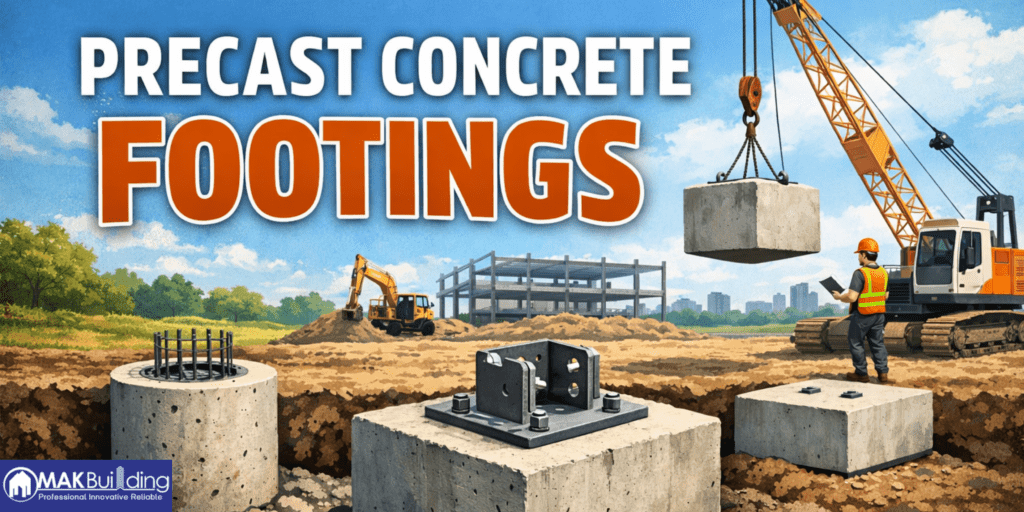
Types of Precast Concrete Footings
Different sites need different footing solutions. Below are the common types we work with.
Isolated Precast Footings
These support single columns or point loads. They are widely used in homes, sheds, and small commercial prefab structures.
Strip or Continuous Footings
These footings are laid against load bearing walls and the weight is evenly distributed over the wall. They are suitable in long structures and boundary walls.
Raft or Mat Footings
Used when soil strength is low, raft footings cover a large area and distribute loads evenly. Theseare common in industrial buildings.
Where Precast Concrete Footings Work Best
We’ve seen precast solutions perform well across many projects. They are a good fit for:
- Residential homes and villas
- Commercial buildings and offices
- Warehouses and factories
- Boundary walls and utility structures
- Pre-engineered buildings
If your site access is tight or the weather is unpredictable, precast concrete footings are worth serious thought.
Installation Process Explained Simply
Many clients ask us if the installation is complex. In reality, it’s quite straightforward when planned well.
Basic Installation Steps
- Excavation of site as per design depth.
- Correct compaction and levelling of soil.
- Installation of precast footing units.
- Alignment and level checks
- Connection with columns or wall systems
Footings are available ready-made, so we save time wasted on mixing, pouring, and curing.
Advice We Continually Give Clients.
Some of the few things that we feel every client ought to take into consideration before settling on precast are as follows:
- Always check soil bearing capacity
- Confirm load calculations with structural drawings
- Ensure proper drainage around the footing area
- Use experienced handling during placement
- Inspect alignment before proceeding upward
Minor tests at this point safeguard the whole construction in the future.
Common Questions We Hear
Are precast concrete footings strong enough?
Yes. Factory-made footings often reach higher strength than site-poured concrete because curing conditions are controlled.
Do they cost more?
The unit cost may look higher, but savings in time, labour, and rework often offset it.
Can they be used for all buildings?
Most low- to mid-rise buildings can use them, but soil conditions and loads determine the final choice.
Why We Recommend Precast Concrete Footings
As seen in MAK Building System Private Limited, precast concrete footings are reliable and meet the demands of modern projects. They minimize is guess work at the most important level of building construction the foundation.
If you are planning a project and want to get off to a good start, you can explore precast solutions on Makbuildings.com to make an informed decision.
A good building does not begin with walls. It is begin with appropriate footing.